VWAP Indicator
VWAP (Volume Weighted Average Price) is the day's average price weighted by volume. Institutional traders use it as a fair value benchmark for the session, one of the most trusted intraday indicators.
What is the VWAP Indicator?
VWAP has been a staple among institutional traders for gauging market direction, and its use has expanded widely among retail traders. It resets each trading day and reflects both price and volume, unlike a simple moving average which only looks at price.
VWAP formula: VWAP = Σ(Price × Volume) / ΣVolume
How to Read VWAP
- Price above VWAP: considered bullish for the session; buyers are paying above the volume-weighted average
- Price below VWAP: considered bearish for the session
- Price crossing above VWAP: often used as a long entry signal
- Price crossing below VWAP: often used as a short entry signal
VWAP is intraday only; it has no meaningful multi-day setting since it's recalculated fresh each session.
Best Use Cases
- Day Trading: VWAP is built for intraday use and is especially effective in liquid markets like Bank Nifty.
- Institutional Benchmarking: funds use VWAP to check if their own execution was better or worse than the market average.
- Combining with Other Indicators: RSI or MACD alongside VWAP can confirm momentum before acting on a crossover.
VWAP doesn't work on Spot charts for indices, since no volume data is available on index spot charts.
How to Automate a VWAP Strategy on Signals AI (No Code)
You don't need TradingView, PineScript, or a webhook to trade VWAP signals. Signals AI is AlgoTest's no-code strategy builder. Describe your VWAP logic in plain English, or build it visually on the Canvas, and it handles backtesting, paper trading, and live execution with your broker.
VWAP parameters on Signals AI: Source (the standard formula uses HLC3; other sources selectable). Optional standard deviation bands can be added around the line.
Example strategy: VWAP crossover (intraday)
| Condition | |
|---|---|
| Entry | Close crosses above VWAP |
| Exit | Close crosses below VWAP |
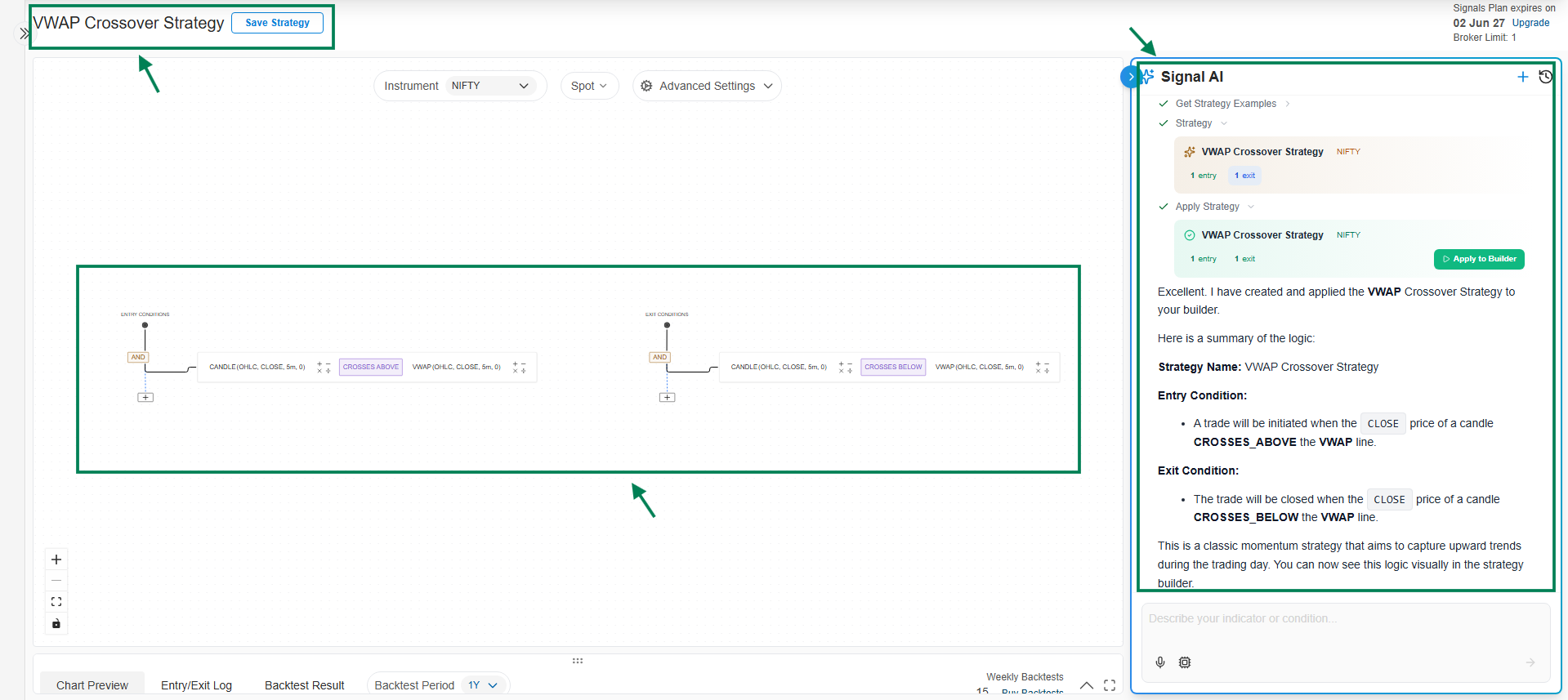
To build this:
- Open Signals AI and tell the AI Agent something like: "Create a VWAP strategy on NIFTY 5-minute futures where entry is Close crossing above VWAP and exit is Close crossing below VWAP." Or add a VWAP Comparison Node manually on the Canvas. Since VWAP needs volume, choose a Futures, Options, or Combined Premium chart rather than index Spot.
- Preview the signal on the chart to confirm entries line up with real VWAP crossovers.
- Connect a trade and backtest it on historical data.
- Forward test it with paper money, then go live once you're satisfied.
→ Full click-by-click walkthrough: Quickstart: Your First Signal in 10 Minutes
VWAP PineScript for TradingView
Prefer TradingView? Here's a ready-to-use VWAP strategy template. Paste it into the Pine Editor, adjust the length, target, and stop loss to your preference, and backtest it.
To learn how to add this pinescript in TradingView, click here.
This strategy is for demonstration purposes only and is not intended for actual trading. AlgoTest is not responsible for any profit or loss arising from the use of this sample strategy.
//@version=5
strategy("VWAP Strategy", overlay=true)

// Input parameters
length = input.int(14, title="VWAP Length")

target_points = input.int(100, title="Target Points")
stop_loss_points = input.int(50, title="Stop Loss Points")

// Calculate VWAP
vwap = ta.vwap(volume, length)

// Strategy logic
long_condition = ta.crossover(close, vwap)
short_condition = ta.crossunder(close, vwap)

// Plot VWAP
plot(vwap, color=color.blue, title="VWAP")

// Strategy entry and exit
if long_condition
    strategy.entry("Long", strategy.long)
if short_condition
    strategy.entry("Short", strategy.short)

// Calculate target and stop loss levels
long_target = strategy.position_avg_price + target_points
long_stop_loss = strategy.position_avg_price - stop_loss_points
short_target = strategy.position_avg_price - target_points
short_stop_loss = strategy.position_avg_price + stop_loss_points

// Strategy exit
strategy.exit("Long Exit", "Long", limit=long_target, stop=long_stop_loss)
strategy.exit("Short Exit", "Short", limit=short_target, stop=short_stop_loss)
Once you've backtested it on TradingView, you can connect the alert to AlgoTest to automate execution, or skip the PineScript and webhook setup entirely by rebuilding the same logic directly in Signals AI above.
FAQ
Understanding VWAP
What does the VWAP tell you?
VWAP provides the average price a stock has traded at throughout the day, based on both volume and price. It is often used as a trading benchmark to determine if a stock is trading at a higher or lower price than usual.
Is VWAP a good indicator?
Yes, VWAP is highly regarded among traders for its ability to reflect the true market sentiment by combining price levels with volume, making it a reliable support and resistance indicator.
Is VWAP bullish or bearish?
VWAP itself is neither bullish nor bearish; it represents an average price. However, prices above the VWAP are typically considered bullish, while prices below the VWAP are seen as bearish.
How is VWAP used in trading?
Traders use VWAP to assess market direction and filter trades. Buying below the VWAP can be seen as buying at a good value, while selling above it can indicate selling at a premium.
How is VWAP value calculated?
VWAP is calculated by adding up the dollars traded for every transaction (price times shares traded) and then dividing by the total shares traded.
VWAP Strategy and Performance
What is VWAP strategy?
A VWAP strategy involves using the VWAP as a trading benchmark to determine entry and exit points for trades, often using it as a target or a stop loss level.
Does VWAP really work?
Yes, VWAP is effective for many traders, especially day traders and those involved in algorithmic trading, as it helps in understanding and acting on real-time price and volume dynamics.
What is the success rate of VWAP?
The success rate can vary widely among traders and depends on additional factors such as market conditions and complementary strategies. It is not a standalone indicator.
How accurate is the VWAP indicator?
VWAP is quite accurate in markets with high volume, as it reflects the true average price weighted by volume, making it reliable during the most active trading periods.
Is trading above VWAP good?
Trading above VWAP can be good if you are looking to sell, as it indicates that the price is above the average day's price weighted by volume.
Is VWAP profitable?
VWAP can be profitable when used correctly, especially in combination with other indicators to confirm trends and provide trade signals.
Is VWMA a good indicator?
The Volume Weighted Moving Average (VWMA) is a good indicator for highlighting the relationship between price and volume and can be particularly useful in determining the strength of a trend.
VWAP Calculation and Settings
How to calculate VWAP formula?
The VWAP formula is: VWAP = Σ(Price × Volume) / ΣVolume.
What is the VWAP ratio?
The VWAP ratio is not a standard metric; it might refer to the comparison of current price to the VWAP value to determine market position.
What is the 5-day VWAP?
The 5-day VWAP extends the standard VWAP calculation across five trading sessions, providing a broader view of the market's average price.
What is the default setting for VWAP?
The default setting for VWAP is typically the current trading day from the market open to the current time or close.
What is the best VWAP length for day trading?
For day trading, VWAP is usually calculated for just the current trading day as it provides the most relevant and immediate trading data.
What are the parameters for VWAP?
VWAP typically does not have adjustable parameters, as it is solely based on price and volume data for the trading day.
VWAP in Different Trading Scenarios
Is VWAP good for swing trading?
VWAP can be used in swing trading to determine entry and exit points, but it is most effective in high-volume environments typically seen in day trading.
What is the best VWAP setting for intraday?
The standard single-day VWAP is most appropriate for intraday trading, providing real-time insights into price and volume.
How do you use VWAP in intraday trading?
In intraday trading, VWAP can be used to identify when a stock is overbought or oversold within the day, helping to make buying or selling decisions.
How do I use VWAP in options?
In options trading, VWAP can help set strike prices or determine the timing of entry and exit, based on the underlying asset's average price.
Is VWAP a daily indicator?
Yes, VWAP is typically recalculated daily, making it most relevant for use within a single trading session.
How do you use VWAP in TradingView?
On TradingView, VWAP can be added to any chart from the indicator menu, and it will automatically calculate and plot based on the trading session's data.
Comparison and Combination with Other Indicators
Is VWAP better than EMA?
Neither is universally better; VWAP is preferred for its incorporation of volume, while EMA provides quicker responsiveness to price changes.
Which indicator works best with VWAP?
Many traders use RSI or MACD in conjunction with VWAP to confirm the strength of the signals provided by the volume and price levels.
What is the best combination with VWAP indicator?
A common effective combination is VWAP with a momentum indicator like the MACD or a trend indicator like the EMA to provide additional trade signals.
What is the difference between VWAP and simple moving average?
VWAP includes volume in its calculation, providing a weighted average, whereas a simple moving average (SMA) only considers price over a set period.
Which indicator is similar to VWAP?
The Volume Weighted Moving Average (VWMA) is similar but uses a simpler moving average approach that incorporates volume.
Anchored VWAP
What is the anchored VWAP?
Anchored VWAP allows traders to select a specific starting point for calculating VWAP, providing customized insights based on a chosen timeframe or significant event.
What is the formula for anchored VWAP?
The formula for anchored VWAP is the same as standard VWAP, but the calculation starts from a user-defined point rather than the beginning of the trading day.
How do you read an anchor VWAP?
Read anchored VWAP like standard VWAP but consider the anchor point's significance (like a recent high, low, or news event) to interpret its impact on current trading levels.
To automate VWAP strategies without writing code, visit AlgoTest Signals AI.